
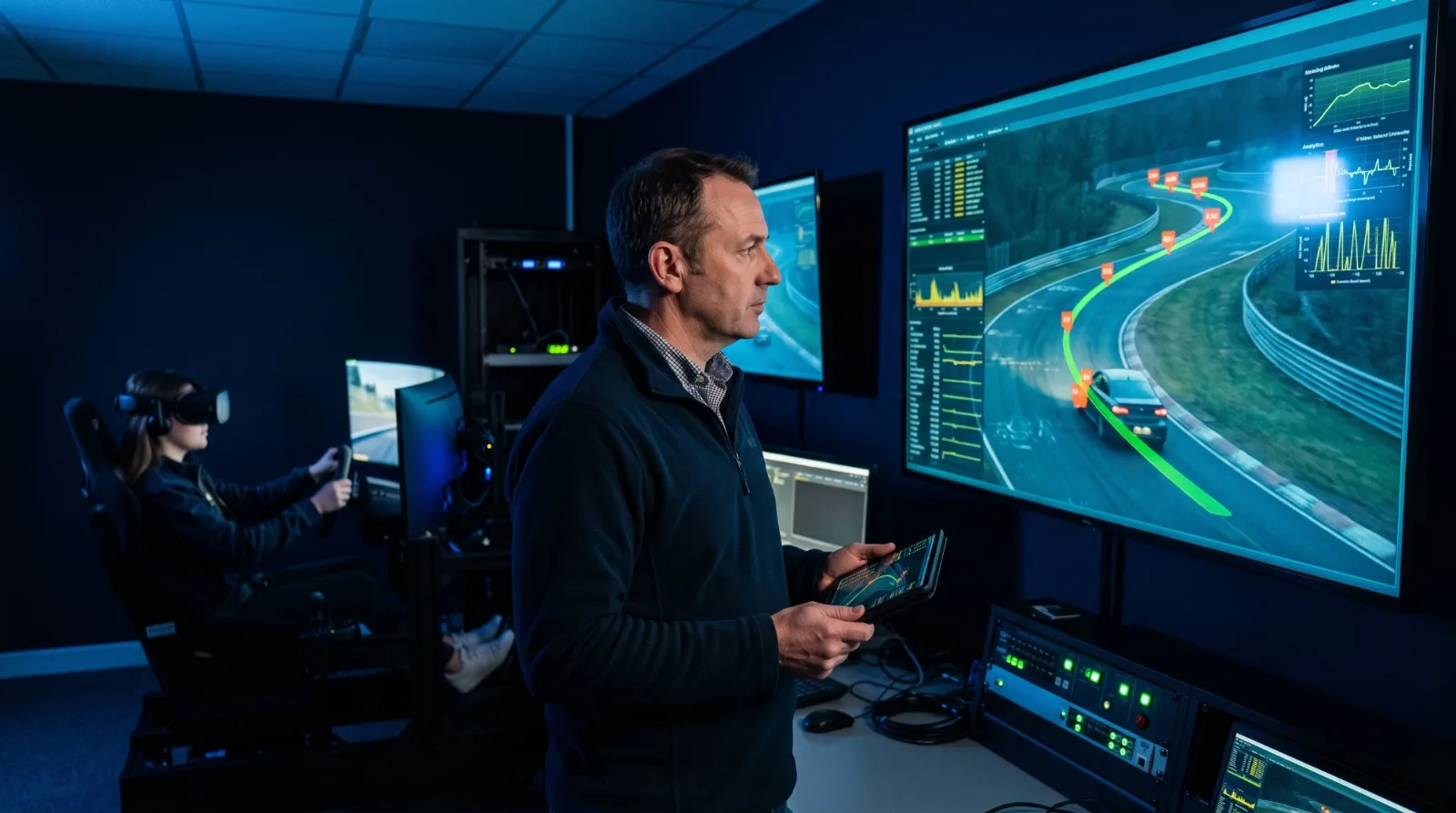
Commentators agree that the biggest structural trend in XR this year is its convergence with artificial intelligence. For training simulators, that raises practical questions: what actually improves, and what stays the same?
Where AI helps
Scenario variety. Hand-built scenarios take time to create, so trainees see the same situations again and again. AI can vary traffic, weather, obstacles and faults so no two sessions are identical.
Adaptive difficulty. A simulator can raise the challenge when a trainee is doing well and ease off when they are struggling, instead of following one fixed script.
Better debriefs. Simulators already record every input. Analytics can turn those logs into clear feedback: where a trainee braked late, which faults they missed, how their performance changed over a week.
Instructor time. When routine assessment is automated, instructors can spend more time coaching the trainees who need it most.
What AI does not change
- Controls still matter. Muscle memory is built in the hands and feet. No amount of AI makes a gamepad feel like a steering wheel.
- Instructors still decide. Scores support judgement, they do not replace it. A qualified instructor still signs off on readiness.
- Realism still depends on good models. Vehicle handling, terrain and physics must be right, or the training teaches the wrong lessons.
- Security still comes first. Many training sites run disconnected. AI features that need a cloud connection may not be usable there.
A sensible order of adoption
- Start with analytics on data you already record, such as automated performance reports.
- Add scenario variation within limits that instructors control.
- Consider adaptive difficulty once you trust the scoring.
- Keep everything that runs in secure facilities on-premise.
Where we stand
Our simulators already produce automated performance reports: VRMMDS scores and logs every session, including fault-injection outcomes, and VRMDFS gives real-time feedback and reports on each flight. On the industrial side, Maquette-XR has AI-driven upgrades on its roadmap for predictive analytics. We add AI where it improves training outcomes, and we keep systems able to run air-gapped where policy requires it.
Want to discuss how AI could fit your training programme? Contact us.