


Operational where it's hard.
Not a demo on a clean floor, VRMMDS is running in the field, on rigs trainees actually use, in terrain that punishes bad equipment.
VRMMDS with the Indian Army.
VRMMDS, our Virtual Reality-based Multi-Mode Driving Simulator, is approved by the Indian Army and endorsed by the Simulator Development Division. It is in operational use across 15+ states. The two deployments below show what that looks like on the ground.
| Customer | Indian Army |
|---|---|
| Approval | Indian Army approved; endorsed by the Simulator Development Division |
| Footprint | Operational use across 15+ states, including Assam and Himachal Pradesh |
| Vehicle types | 8: four light motor vehicles and four heavy motor vehicles |
| Terrains | 7, from metalled highway to broken mountain track, with rain, fog, day and night |
| Hardware | Oculus Quest 2 headset, Logitech G29 wheel with force feedback, real pedals and seat, in a portable rig |
| Deployment | Portable, multi-base, air-gap capable, on-premise |
| Saving | ₹19 lakh per unit compared with live-vehicle training |
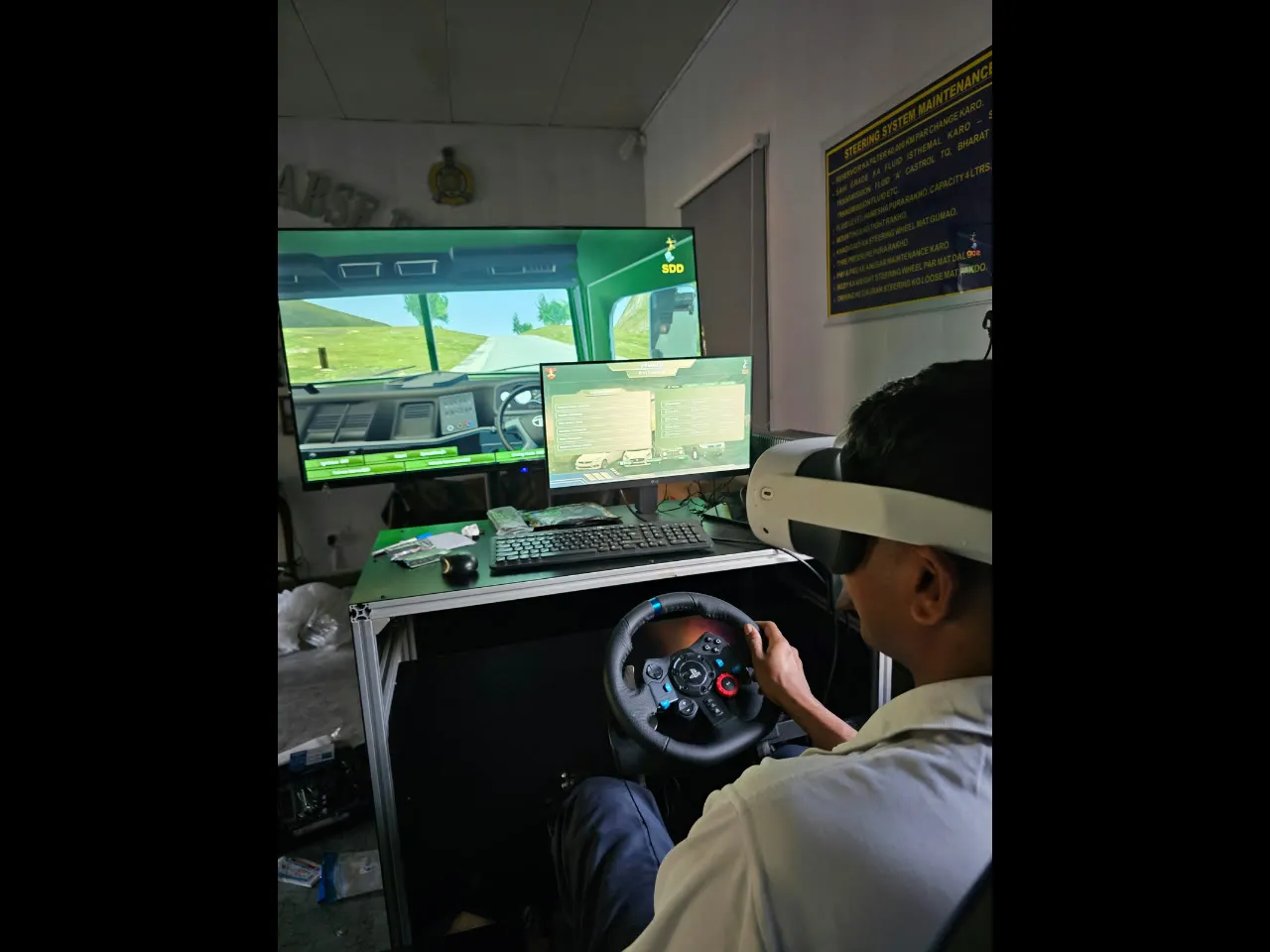
Driver training in operational Army use, Assam.
Real hardware, real trainees, automated performance reports, not a pilot in a lab. Drivers train across 8 vehicle types and 7 terrains on the same rig soldiers use day to day.
The challenge
Every live training hour burns fuel, wears out parts and takes a vehicle away from the unit. Monsoon rain is a normal training condition in Assam, and judgement from the passenger seat varies between instructors, so readiness is hard to compare from one driver to the next.
What was deployed
- VRMMDS rigs with a real wheel, pedals and seat, and a VR headset that puts the trainee in the vehicle and the terrain
- All 8 vehicle types, four light and four heavy, each modelled for its own handling
- Instructor tools for real-time mechanical and environmental fault injection
How training runs
- Drive Trainees work through the vehicle types and terrains on the same rig, in rain, fog, day or night.
- Inject Instructors trigger faults mid-session to build the response under pressure.
- Score Every session is scored and logged automatically.
- Review Instructors get objective, repeatable reports, including fault-injection outcomes, to compare across drivers.
The outcome
Each unit saves ₹19 lakh compared with training on live vehicles. Mistakes cost nothing and harm nobody, and live hours are kept for what only a real vehicle can teach.
Mountain driver training in Himachal Pradesh.
Mountain terrain, poor visibility and steep grades, exactly the conditions the simulator was built to rehearse before a driver ever faces them for real.

The challenge
Mountain gradients, monsoon rain and low visibility are normal conditions here. A brake failure on a mountain descent is too dangerous to create for real, and vehicles have to be moved to wherever the trainees are.
What was deployed
- Portable VRMMDS rigs that move with the unit instead of being fixed to one training hall
- Mountain terrain up to broken track, with rain, fog and night on demand
- Air-gap capable, on-premise setup, so training runs disconnected where policy requires it and data stays inside the facility
How training runs
- Rehearse Drivers practise steep grades and low visibility before they meet them on a real road.
- Inject Instructors trigger emergencies such as mechanical faults on a descent, which cannot be staged safely in a real vehicle.
- Score Every session is scored and logged, so readiness is comparable across units.
- Qualify Live driving stays essential for final qualification; the simulator prepares trainees for it.
The outcome
Harder terrain and more trainees, on the same number of vehicles. Because the rigs are built for multi-base deployment, training can be standardised across units without shipping vehicles between them.
Questions about VRMMDS deployments.
Where is VRMMDS deployed?
It is in operational use with the Indian Army across 15+ states, including Assam and Himachal Pradesh, where monsoon rain, mountain gradients and low visibility are normal training conditions. Full operational details are available under NDA.
Is VRMMDS approved by the Indian Army?
Yes. VRMMDS is approved by the Indian Army and endorsed by the Simulator Development Division.
How much does it save?
Each unit saves ₹19 lakh compared with training on live vehicles. Ask us for a deployment briefing and we will walk you through the outcomes.
Can the rigs move between units?
Yes. The rigs are portable and built for multi-base deployment, so training can be standardised across units without shipping vehicles between them.
Can it run without a network connection?
Yes. VRMMDS is air-gap capable and can be deployed on your own premises, so it runs fully disconnected where policy requires it and training data stays inside your facility.
More on the platform: VRMMDS specifications · Military training simulators · Why the Army is moving training into simulators
Ask for a VRMMDS deployment briefing.
Our engineers walk you through Assam and Himachal Pradesh: the outcomes, the hardware, and what it took to stand each site up.