
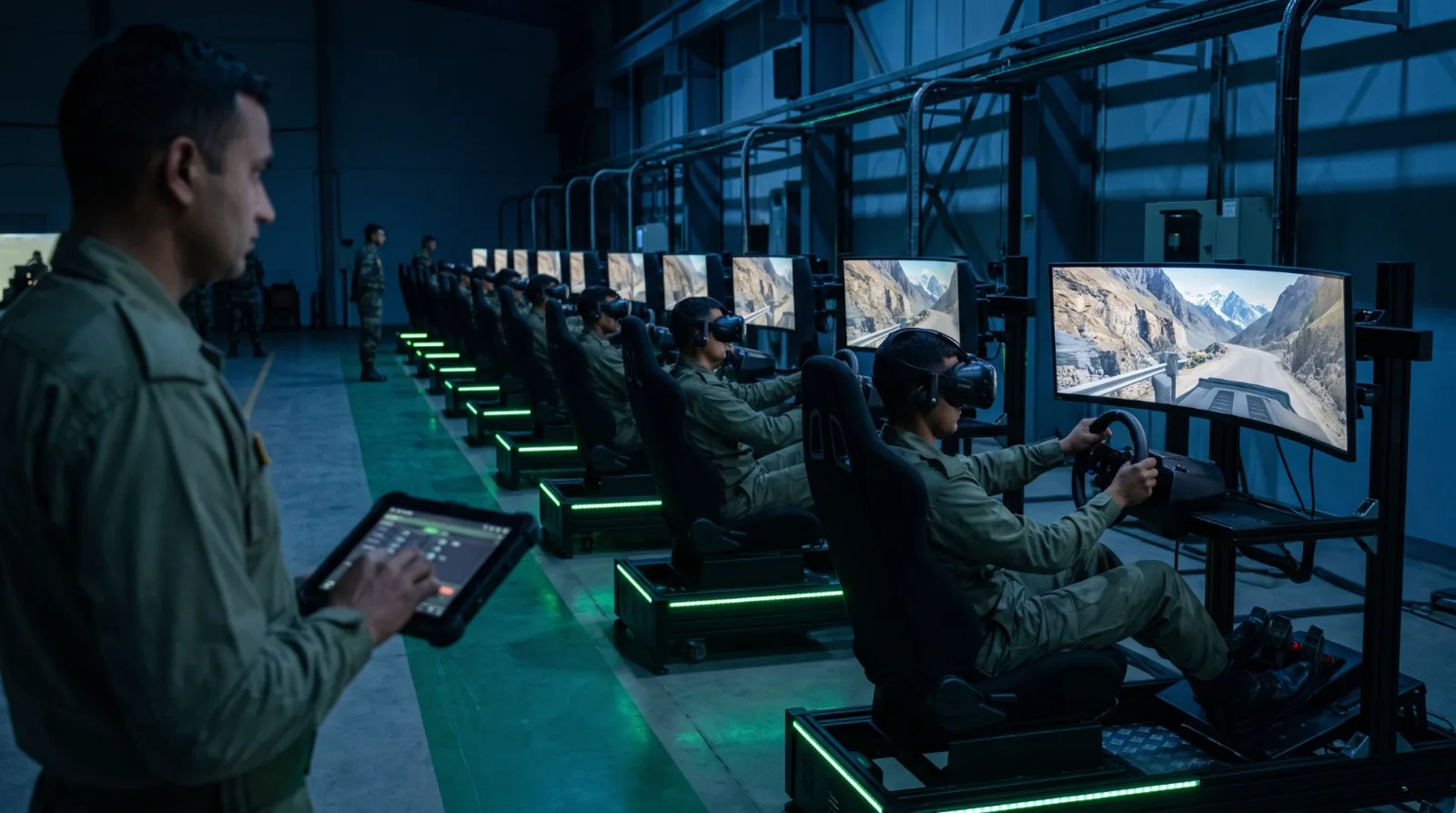
Simulation used to be a special item in military training, reserved for aircraft and a few expensive platforms. In 2026 it is becoming routine across the Indian Army.
What has changed this year
Several announcements show the direction:
- In May 2026, the Simulator Development Division under the Army Training Command (ARTRAC) handed over an indigenous VR-based aerial delivery training simulator to the Army Airborne Training School in Agra, designed for C-17, C-130J and Chinook platforms. Indian Defence News reported it as a way to cut reliance on live aircraft for costly training missions.
- The Army's Combat Training Network, as reported by Halldale, is built around live-virtual-constructive training, weapons simulators, drone drills and after-action analytics.
- Senior officers visiting the Simulator Development Division in Secunderabad in April 2026 were briefed on simulation-based training and indigenous capability development.
The reasons behind the shift
Cost per trained soldier. Every hour on a real vehicle or aircraft burns fuel, wears out parts and ties up an asset. A simulator hour costs a fraction of that, and the saving grows with the size of the force being trained.
Safety. Trainees can make their first mistakes where nobody gets hurt and nothing gets damaged. Instructors can also inject failures, like a brake fault on a mountain descent, that would be far too dangerous to create for real.
Conditions on demand. Monsoon rain, fog, night and high altitude can be scheduled rather than waited for.
Measurement. A simulator records everything. Instructors get objective scores for each trainee instead of relying only on judgement.
Self-reliance. Indigenous simulators can be adapted to Indian vehicles, terrain and doctrine, and supported locally.
Where driving fits
Driver training is one of the clearest cases. Army drivers must handle light and heavy vehicles on roads that range from highway to broken mountain track, often in bad weather. Our VRMMDS driving simulator, approved by the Indian Army and endorsed by the Simulator Development Division, puts trainees in a real rig with a steering wheel, force feedback and pedals across eight vehicle types and seven terrains. Each unit saves Rs 19 lakh compared with training on live vehicles.
What to ask before buying a training simulator
- Does it use real controls, or a keyboard and gamepad?
- Can instructors inject faults and change the weather mid-session?
- Does it produce reports that fit your assessment process?
- Can it be moved between units, and run without an internet connection?
- Who supports it, and how quickly?
Want to see how simulation fits your training plan? Talk to our team.