
Building information modelling (BIM) is spreading quickly across Indian construction, especially on metro rail, airport and smart city projects. At the same time, a lot of what is written about BIM "mandates" in India is inaccurate.
What is actually required
According to InfraLens, India does not yet have a comprehensive national policy enforcing BIM on public projects, and several widely repeated claims about agencies mandating BIM above certain project values are unverified or overstated. What does exist:
- Project-level requirements. Agencies such as DMRC, CIDCO and NBCC set BIM deliverables in specific contracts.
- A national BIM policy in development, aimed at standardising practice across states.
- Market pull. Large developers and international partners increasingly expect BIM on their projects.
So for most firms in 2026, BIM is less a legal requirement than a competitive one. Clients are asking for it, and projects that use it well waste less.
The gap BIM alone does not close
A BIM model is only as useful as its connection to what is happening on site. Most costly errors happen in the gap between the model in the office and the concrete on the ground: a duct routed differently, an opening in the wrong place, a column slightly off.
These disparities are cheap to fix when caught early and expensive once the next trade has built on top of them.
How AR brings the model to site
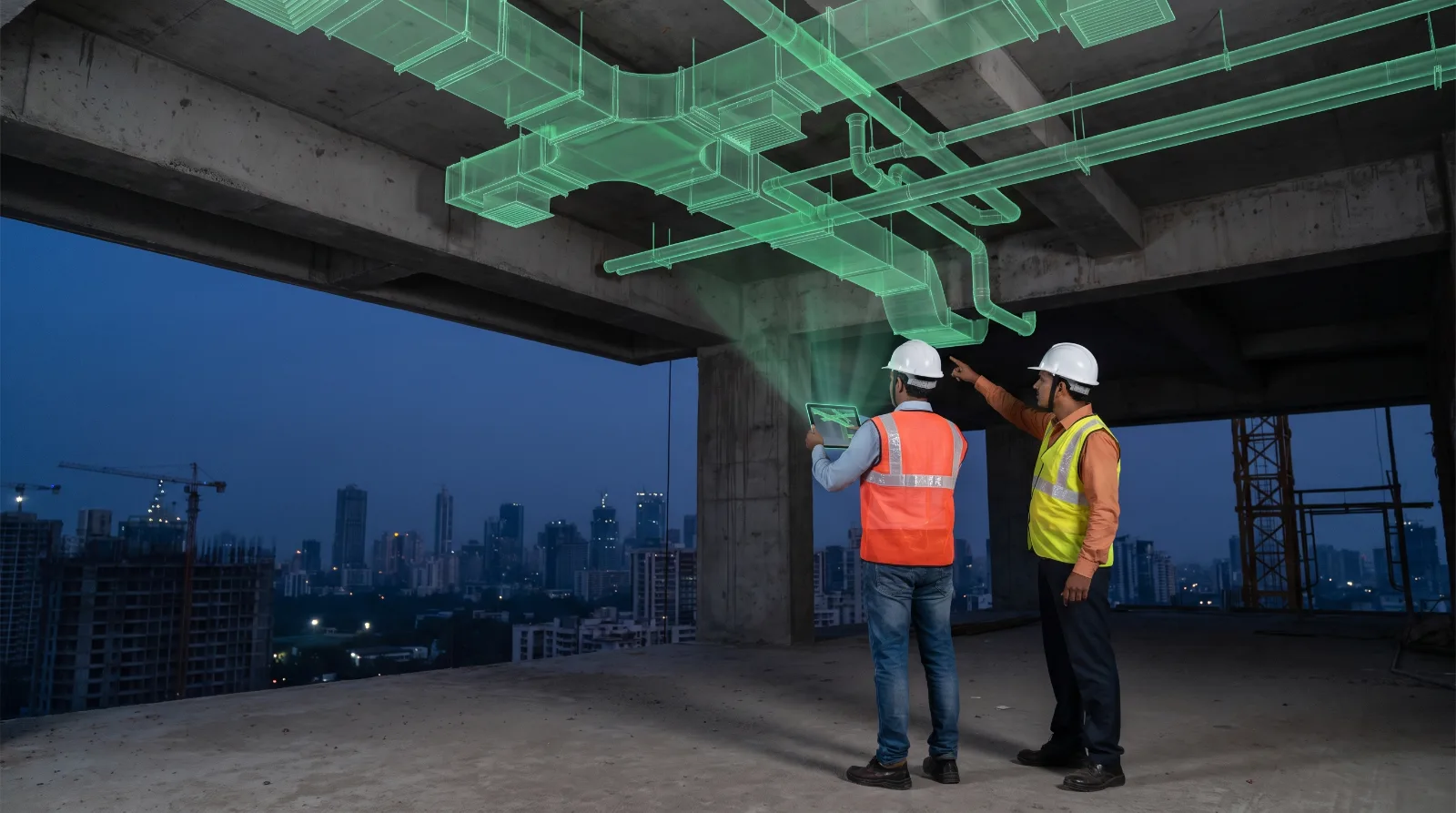
Augmented reality overlays the 3D BIM model on the real site, seen through a tablet or headset. Site teams can:
- Compare design and reality on the spot, element by element.
- Catch clashes and disparities before the next trade covers them.
- Review designs together on location, with all stakeholders looking at the same thing.
- Previsualise designs on the actual plot before ground is broken.
Getting started with AR on site
- Start with a project that already has a good BIM model.
- Choose one stage where errors are costly, such as MEP rough-in.
- Run AR checks at fixed points in the schedule and log what they catch.
- Compare rework costs with a similar project that did not use AR.
MOE AR
MOE AR is our augmented reality application for construction disparity identification. It overlays the BIM model on the job site so architects, engineers and project managers can spot errors and confirm the project is built as designed.
Bring us your BIM model and we will show you what AR finds on your site.