
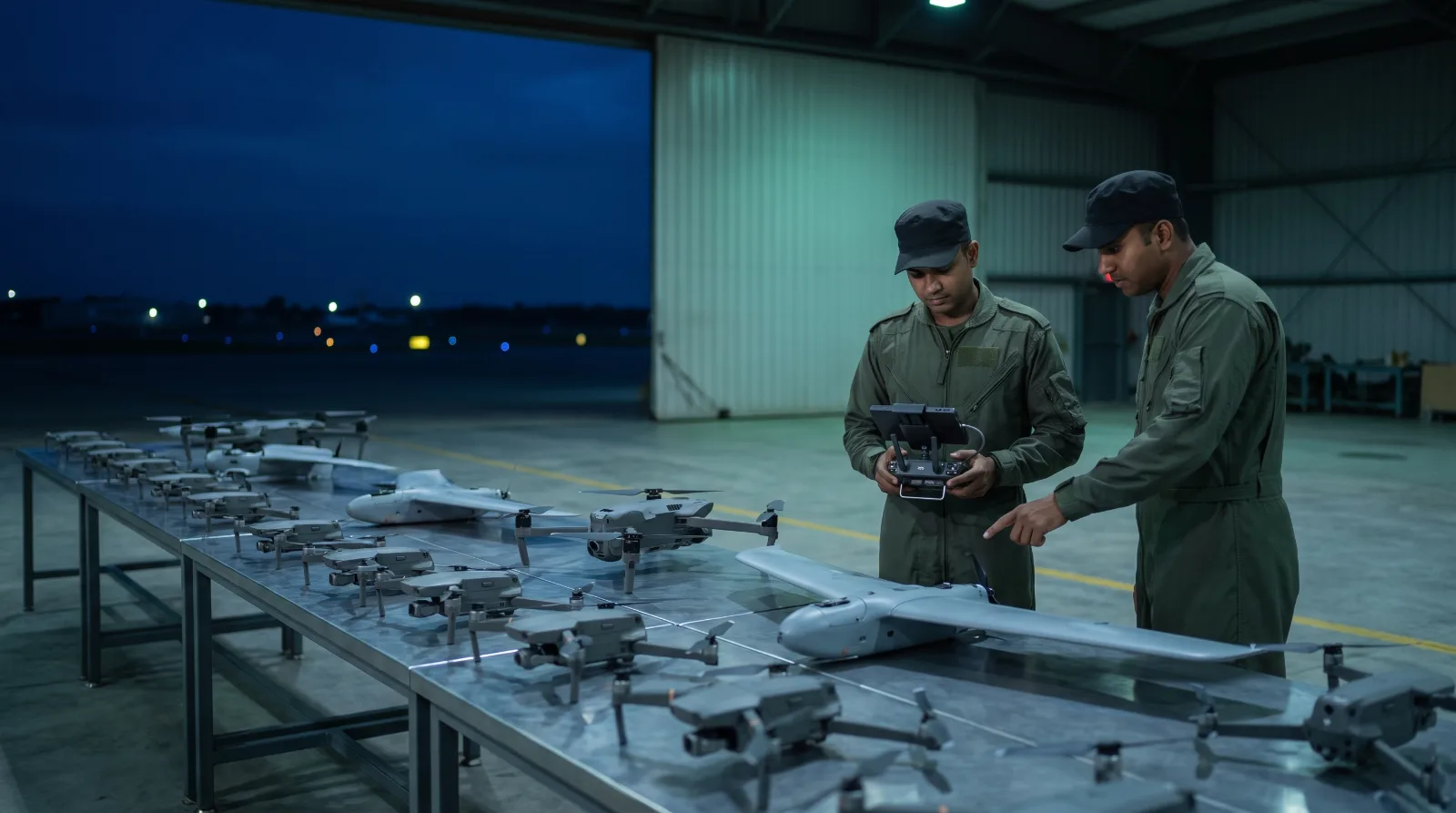
In June 2026, Defence Minister Rajnath Singh released the Delegation of Financial Powers to Defence Services 2026 (DFPDS-2026), moving procurement decisions worth over Rs 1.25 lakh crore closer to the armed forces, as Raksha Anirveda reported.
One provision stands out for anyone involved in drones. According to Defence Standard, field commanders across the Army, Navy, Air Force and Integrated Defence Staff can now buy runway-independent drones with a range of up to 100 km and endurance of up to six hours, costing up to Rs 5 crore each, from their own command-level budgets.
What changes
Until now, most drone buys went through long capital procurement cycles. Under DFPDS-2026, a command that needs drones can buy them far faster. That is good for readiness. It also moves the bottleneck.
When drones arrive in months instead of years, the limiting factor becomes trained pilots. A unit with new drones and too few qualified operators has bought hardware, not capability.
The training gap
Three things make drone training harder than it looks:
- Volume. The Army aims for every soldier to be trained in drone operations, and The Week reports about 50,000 trained in the past year alone.
- Variety. Units now operate multirotors, fixed-wing aircraft and cargo drones, each with different handling.
- Attrition. Every crash in live training costs an airframe that could be in service.
Plan training with the purchase
Commands buying drones under the new powers can avoid the gap by planning training at the same time:
- Count pilots, not airframes. Work out how many qualified operators each drone needs across shifts and leave.
- Start before delivery. Pilots can build control familiarity before the aircraft arrive.
- Train on the types you are buying, in the terrain you operate in.
- Measure readiness with objective scores rather than hours logged.
- Reserve live flying for what only live flying can teach.
Where simulation fits
A drone simulator lets many pilots train at once, without risking airframes, in terrain and weather that may not be available locally. Our VRMDFS drone flying simulator covers seven drone types, from fixed-wing and hexacopter to the mR-20 cargo drone, across ten terrains including glaciated, high-altitude, desert and built-up areas. Pilots fly a custom RC controller, five or more can train in the same session, and every session produces a performance report.
Planning drone training alongside a purchase? Talk to our defence team or see our defence training systems.