
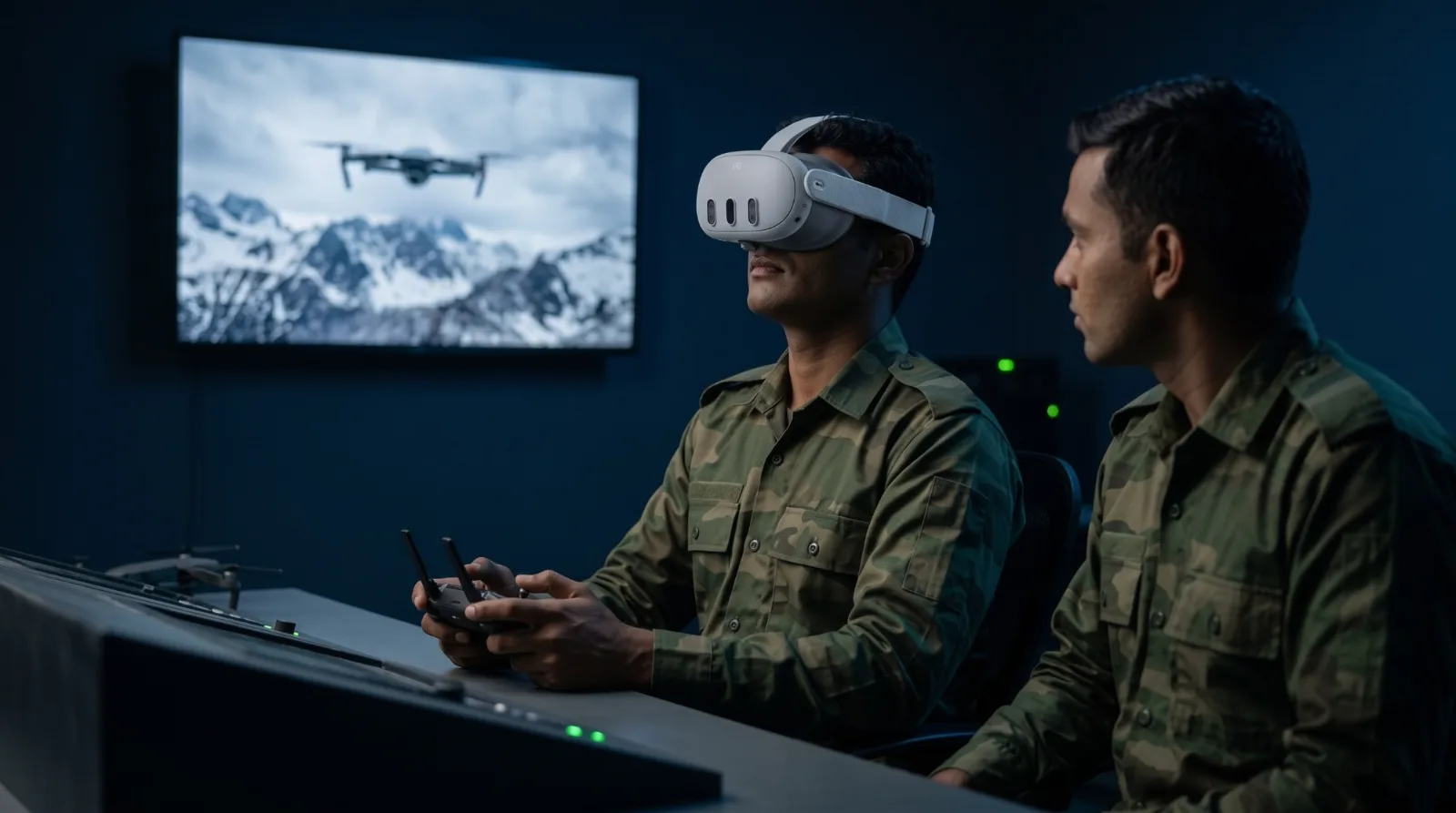
The drone has become what Army leadership now calls the "third arm" of the soldier. After Operation Sindoor in May 2025, the Indian Army set a goal that every soldier should be trained in drone operations by 2027, and it has drawn up a roadmap to train around five lakh personnel over five years. According to The Week, about 50,000 officers and soldiers were trained on remotely piloted aerial systems in the past year, under a drone warfare framework running across 19 training establishments.
Those numbers change the problem. Training a few specialist pilots is a question of instructors and airframes. Training an entire force is a question of throughput.
Why live flying alone cannot carry the load
Every live training flight costs something: a battery cycle, wear on the airframe, range time, a safety officer, and good weather. A crash on day two of a course costs a drone. Multiply that by lakhs of trainees and the limits are obvious.
- Airframes are finite. Each drone a trainee crashes is one fewer for the next batch.
- Weather decides the schedule. Wind, rain and poor visibility ground training flights, yet those are exactly the conditions pilots must handle in the field.
- Terrain is fixed. A training area in the plains cannot teach glaciated ground or a built-up area.
- Mistakes are expensive. The cheapest place to make the first hundred mistakes is not in the air.
What a simulator should do in a drone course
A simulator does not replace live flying. It makes each live flight count, because trainees arrive already familiar with the controls. For that to work, a few things matter:
- The controller has to feel right. Muscle memory is built in the hands. A generic gamepad teaches the wrong reflexes.
- Several aircraft types. Fixed-wing and multirotor drones fly very differently, and cargo drones behave differently again.
- Many terrains and weather conditions, so the first time a pilot meets high altitude or a crosswind is not on operations.
- Many pilots at once. Throughput is the whole point, so one instructor should be able to run a group.
- Objective reports. Scores and logs let instructors see who is ready for live flying and who needs more hours.
How VRMDFS approaches it
Our Virtual Reality Military Drone Flying Simulator (VRMDFS) was built around those needs. Trainees fly seven drone types, from fixed-wing to hexacopter and the mR-20 cargo drone, across ten terrains including glaciated, high-altitude, jungle, desert and built-up areas. They use a custom RC controller with precision joysticks, five or more pilots can train in the same session, and three difficulty modes take them from first flights to advanced practice. Every session produces a performance report.
The takeaway
The goal of universal drone training is ambitious, and it will be reached by blending classroom theory, repeated simulator practice and targeted live flying. The simulator is where the volume happens.
If you are planning drone training for a unit or an institution, request a demonstration and fly it yourself.