
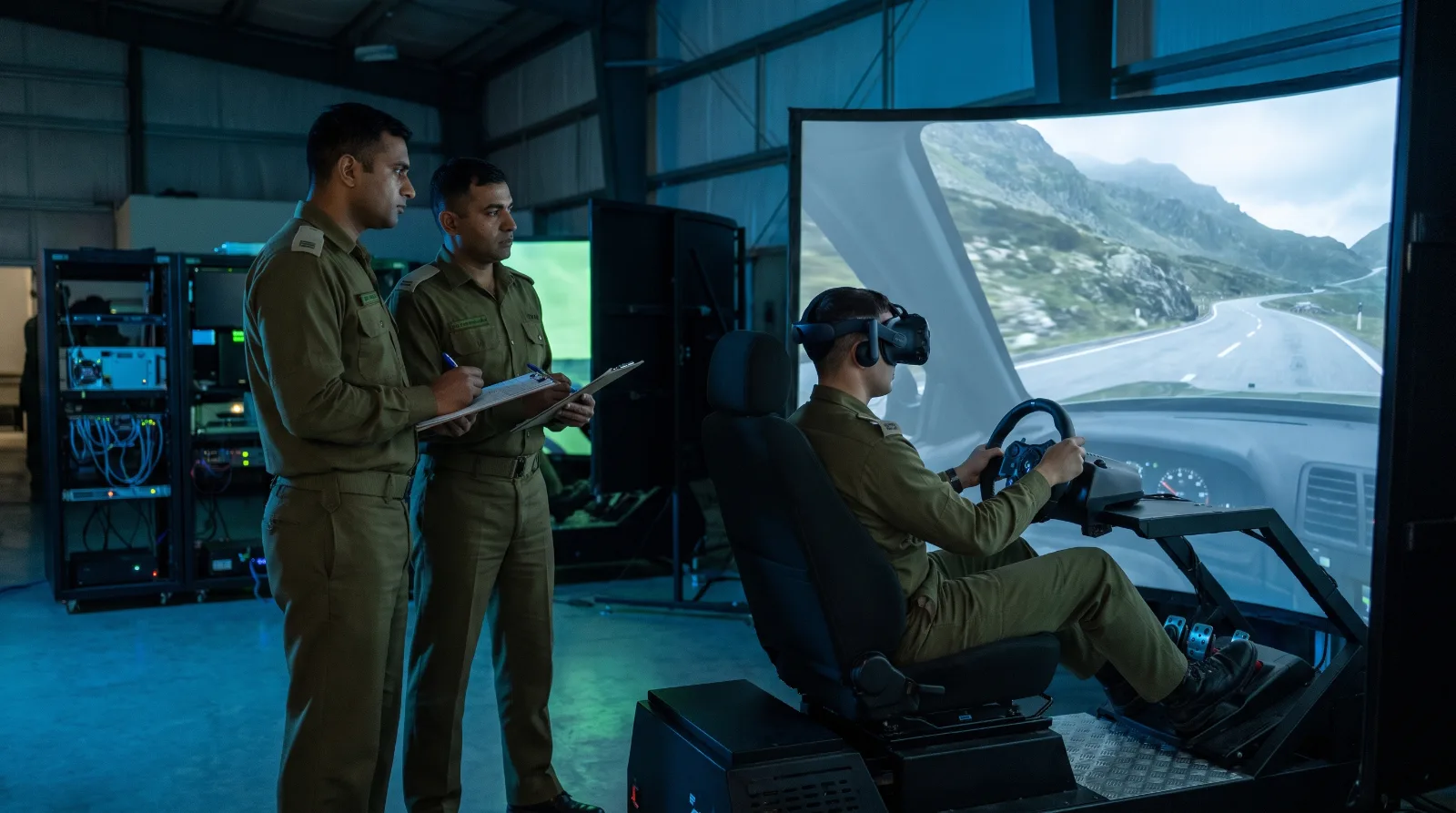
A good demonstration can make any driving simulator look impressive. What matters is whether it changes how well drivers perform on real roads, in real conditions. These ten questions help procurement teams and training officers compare systems on what they teach.
1. Which vehicles does it cover, by name?
"Multiple vehicle types" is not an answer. Ask for the list, light and heavy, and how each one's handling differs. A driver trained on the wrong vehicle dynamics learns the wrong reflexes.
2. Are the controls real?
Muscle memory is built in the hands and feet. Look for a real steering wheel with force feedback, real pedals and a proper seat. A gamepad or keyboard teaches nothing that transfers.
3. Which terrains and conditions can it recreate?
Ask for the terrain library by name, from highway to broken mountain track, and whether rain, fog and night can be switched on during a session.
4. Can the instructor create emergencies?
Brake failures, tyre bursts and loss of visibility are too dangerous to stage for real. A training simulator should let the instructor trigger faults mid-session and see how the trainee responds.
5. What does the report actually measure?
Ask to see a real report, not a slide. Which measures are recorded for every session, and can progress be compared across trainees and units?
6. Can it run without a network?
Many training establishments cannot connect equipment to outside networks. Ask whether the system runs fully air-gapped, including licensing and start-up, and where training data is stored.
7. Can it move between bases?
If you train at more than one location, portability matters. Ask how long it takes to move a rig and bring it back into service.
8. Who supports it, and from where?
Ask about warranty, spare parts for controls that wear, response times and where support engineers are based.
9. Has it been used in conditions like yours?
A simulator that works in a clean demonstration room may not survive monsoon humidity or a remote mountain post. Ask for deployments in comparable conditions and for references.
10. What does it save compared with live training?
Ask for the cost comparison against live-vehicle training: fuel, wear, vehicles out of service. A vendor with real deployments should be able to show the numbers.
How VRMMDS answers
Our VRMMDS driving simulator was built around these questions: eight vehicle types (four light, four heavy), seven terrains with rain, fog and night, a Logitech G29 wheel with force feedback and real pedals, real-time fault injection, automated scored reports, air-gap capability and portable multi-base rigs. It is approved by the Indian Army, in operational use across 15+ states including Assam and Himachal Pradesh, and saves Rs 19 lakh per unit compared with live-vehicle training.
Planning a procurement? Ask us for a deployment briefing or see VRMMDS on a real rig.