
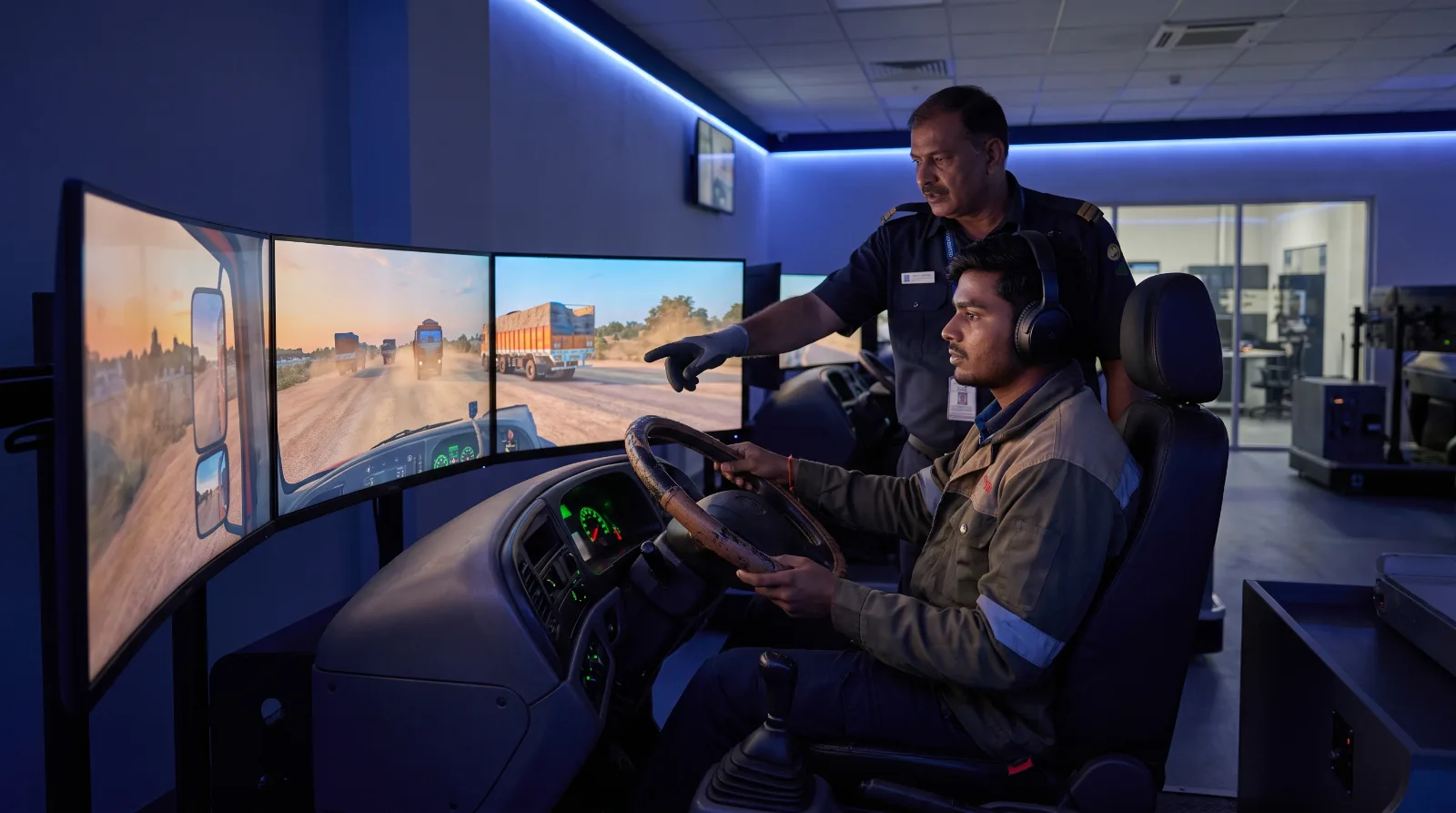
India's roads are short of skilled drivers. In Parliament in April 2025, Road Transport Minister Nitin Gadkari cited a World Bank estimate that the country is short of 22 lakh drivers, and described a Rs 4,500 crore scheme to set up 1,600 driving training institutes across states and Union Territories, as reported by Business Standard.
Training that many drivers well is a capacity problem, and the heaviest part of it is heavy vehicles: trucks, buses and specialised transport.
Why heavy vehicle training is hard
- Vehicles are expensive to take off the road for training, and fuel costs add up quickly.
- Mistakes are dangerous. A novice in a loaded truck is a risk to everyone around them.
- Rare situations are the ones that matter. Brake fade on a long descent, a tyre failure, a skid in rain. A trainee may never meet these during a course, yet must handle them on the job.
- Assessment is subjective when it depends only on an instructor's view from the passenger seat.
What simulation adds
A driving simulator lets a trainee practise the same manoeuvre dozens of times, meet bad weather and night driving on schedule, and face emergencies safely. Instructors can trigger faults at the worst possible moment and see how the trainee responds, then review a scored report afterwards.
This is why simulators appear in modern driver training centres alongside classrooms and test tracks. The simulator handles repetition and rare events. The road handles everything else.
What to look for in a driver training simulator
- Real controls. A proper steering wheel with force feedback, pedals and a seat build habits that transfer to the vehicle.
- Light and heavy vehicles on one platform, so a centre does not need separate rigs for each class.
- Varied terrain and weather, including hills, rain, fog and night.
- Fault injection controlled by the instructor.
- Automated reporting that gives each trainee an objective score.
- Portability, if training happens at more than one site.
Built for the hardest conditions
Our VRMMDS simulator was developed for military drivers, one of the most demanding training environments there is. It covers four light and four heavy vehicle types across seven terrains, with dynamic weather, real-time fault injection and automated performance reports. It is approved by the Indian Army and saves Rs 19 lakh per unit compared with training on live vehicles.
If you run a fleet, a training institute or a transport operation, request a demonstration.