
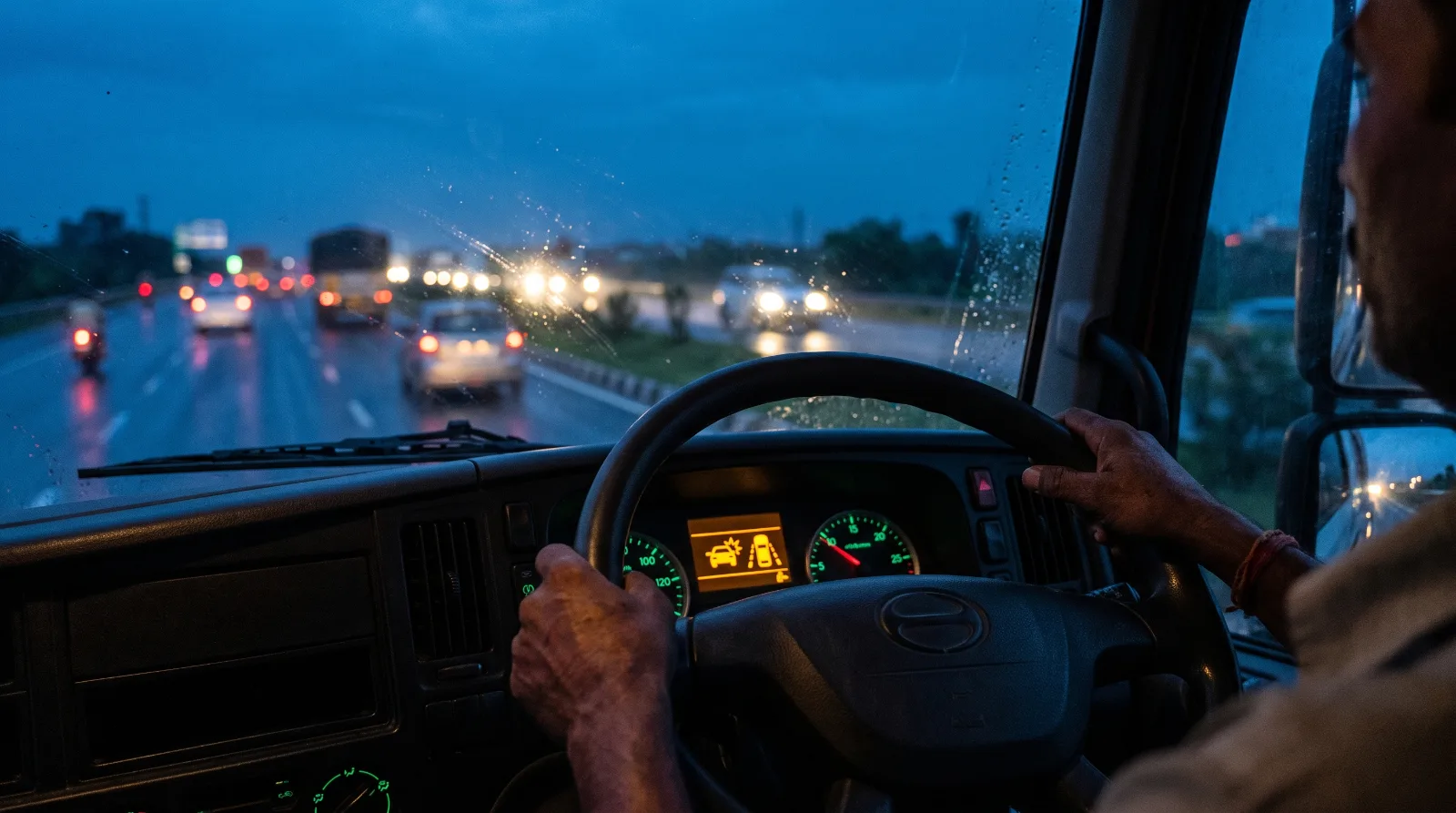
India has set firm dates for advanced safety systems on commercial vehicles. Under G.S.R. 834(E), notified by the Ministry of Road Transport and Highways on 11 November 2025, new models of buses (M2, M3) and trucks (N2, N3) must meet these requirements, as summarised by Binary Semantics:
- From 1 October 2027: the revised braking standard, Electronic Stability Control (ESC) and an Advanced Emergency Braking System (AEBS).
- From 1 January 2028: Driver Drowsiness and Attention Warning, Blind Spot Information, Moving Off Information and Lane Departure Warning.
Fleet operators will see these systems arrive with each new vehicle. The technology is only half the change. The other half is the driver.
Why the driver still matters
Advanced driver assistance systems (ADAS) warn and, in some cases, intervene. They do not drive the vehicle. A driver who does not understand what a warning means, or who has never felt an emergency brake intervention, can react badly: braking late, over-correcting, or switching a system off because it "keeps beeping".
Research on driver assistance everywhere points to the same risks:
- Over-reliance. Drivers who trust the system too much pay less attention.
- Alert fatigue. Too many warnings, not understood, get ignored.
- Surprise. The first time AEBS brakes hard should not be on a loaded truck on a highway.
What drivers need to learn
- What each system does and does not do. ESC helps keep the vehicle stable; it cannot beat physics on a steep, wet descent at the wrong speed.
- What each warning means, and the right response to it.
- How the vehicle feels when a system intervenes, so the reaction is calm and practised.
- Good driving without the systems, because older vehicles stay on the road for years alongside new ones.
Where simulation fits
Most of this is hard to teach on a real road. Emergencies cannot be staged safely, and a trainee may drive for months without meeting a real hazard. A driving simulator lets instructors create those situations on demand: a vehicle cutting in, a skid in rain, a brake failure on a descent. Trainees practise the response until it is automatic, and every session is scored.
Our VRMMDS driving simulator covers four light and four heavy vehicle types across seven terrains, with rain, fog and night. Instructors inject mechanical and environmental faults mid-session, and every session is scored and logged automatically. It was built for the Indian Army and is in operational use across 15+ states.
A practical plan for fleets
- Audit which vehicles in your fleet will carry which systems, and when.
- Add a module on warnings and interventions to driver induction.
- Use simulator sessions for the emergencies these systems are designed to prevent, so drivers understand both the hazard and the system.
- Measure: track incidents and near-misses before and after.
Training drivers for the new rules? See our driver training for fleets or book a technical call.