

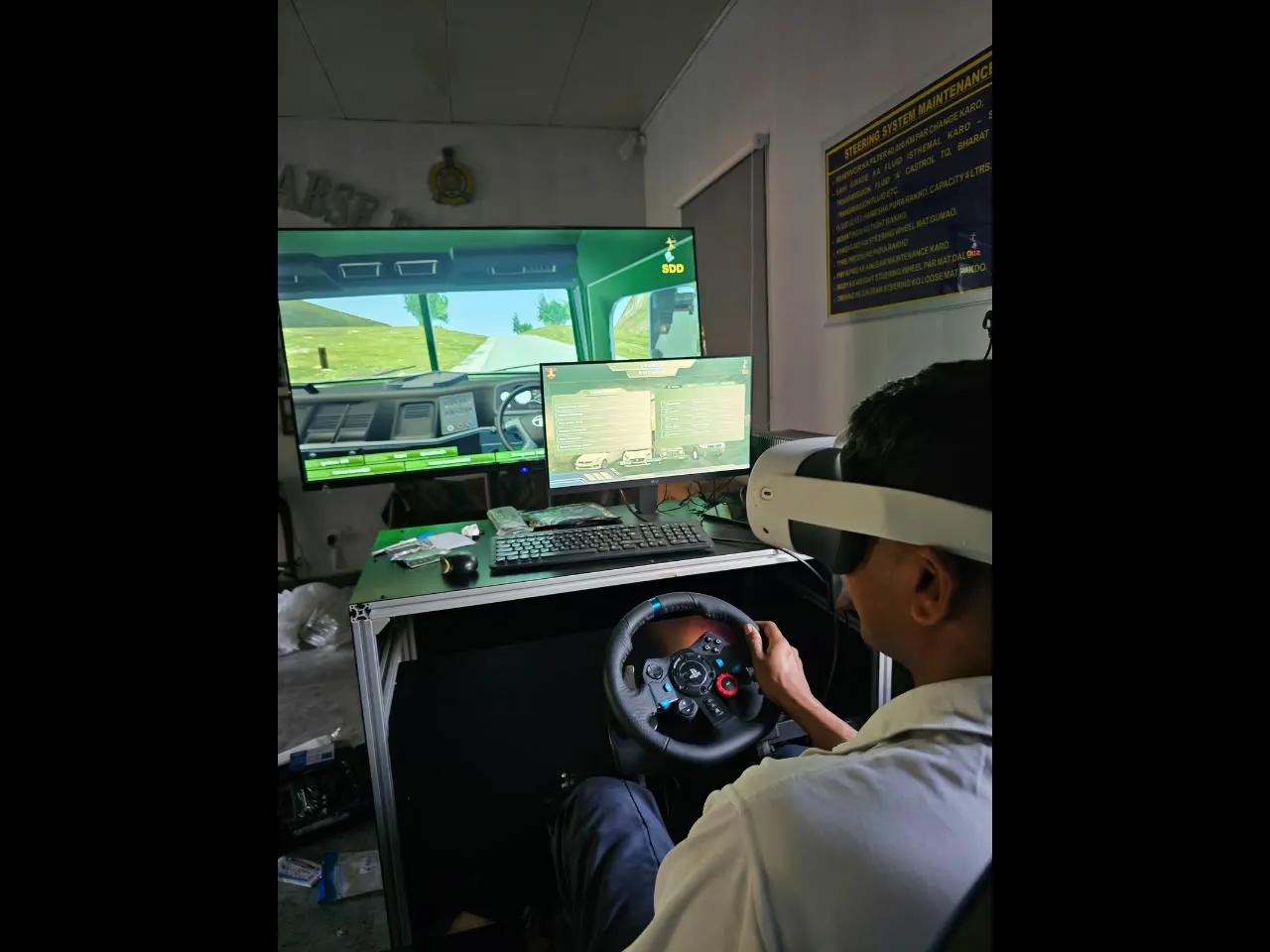
Driver training simulators for fleets and transport operators.
VRMMDS trains drivers of light and heavy vehicles on a real wheel and pedals, across seven terrains and all weather, with a scored report for every session. It was built for the Indian Army, one of the hardest driver-training environments there is.
More drivers needed, and live training is the bottleneck.
India is short of skilled drivers: in April 2025 the Road Transport Minister cited a World Bank estimate of a 22 lakh shortfall, and a scheme for 1,600 driving training institutes. Training that many drivers well depends on how much practice each one gets.
Every training hour takes a truck or bus out of service and burns fuel.
Brake fade on a descent, a skid in rain or a tyre failure are hard to practise, yet they cause the worst incidents.
Live training happens in daylight and good weather; real driving does not.
Two instructors can judge the same drive differently. A scored report does not.
Real controls, measured results.
Trainees sit in a real rig with a Logitech G29 steering wheel with force feedback, pedals and a seat, while the headset puts them on a highway, a mountain road or a monsoon convoy route. Instructors inject mechanical and environmental faults mid-session, and every session is scored and logged automatically, so readiness can be compared across drivers and sites.

Built for organisations that train drivers at scale.
Train and re-assess light and heavy vehicle drivers without taking vehicles off the road.
Standardised, measurable driver assessment across depots and regions.
Objective, repeatable practice sessions alongside classroom and track time.
Portable rigs move between sites, so every location trains the same way.
From our blog.
India needs 22 lakh skilled drivers
Where simulators fit in closing the gap.
Read →Why training is moving into simulators
Cost, safety, conditions on demand and measurement.
Read →The VRMMDS platform
Specifications, the simulator-vs-live comparison and FAQs.
View platform →Questions buyers ask about Mobility.
Which vehicles can drivers train on?
Eight vehicle types: four light motor vehicles and four heavy motor vehicles, each modelled for its own handling characteristics.
How is a driver assessed?
Every session is scored and logged automatically, so instructors get objective, repeatable reports they can compare across drivers and sites.
Can instructors create emergencies?
Yes. Instructors can inject mechanical and environmental faults in the middle of a session to train the response under pressure.
Does it replace on-road training?
No. It takes on the repetition, rare emergencies and measurement, so live hours are spent on what only a real vehicle can teach.
Can the simulator move between our sites?
Yes. The rigs are portable and built for multi-site deployment.
Size your driver programme.
Tell us how many drivers you train, which vehicles and where. We will show you VRMMDS on a real rig, at T-Hub in Hyderabad or at your site.